
ECON 121 Discussion: Week 7
Slides available here:
All discussion slides here:

Today’s Plan
- Midterm 1 review
- Long-Term GDP Growth Practice Problems
Midterm 1 Review
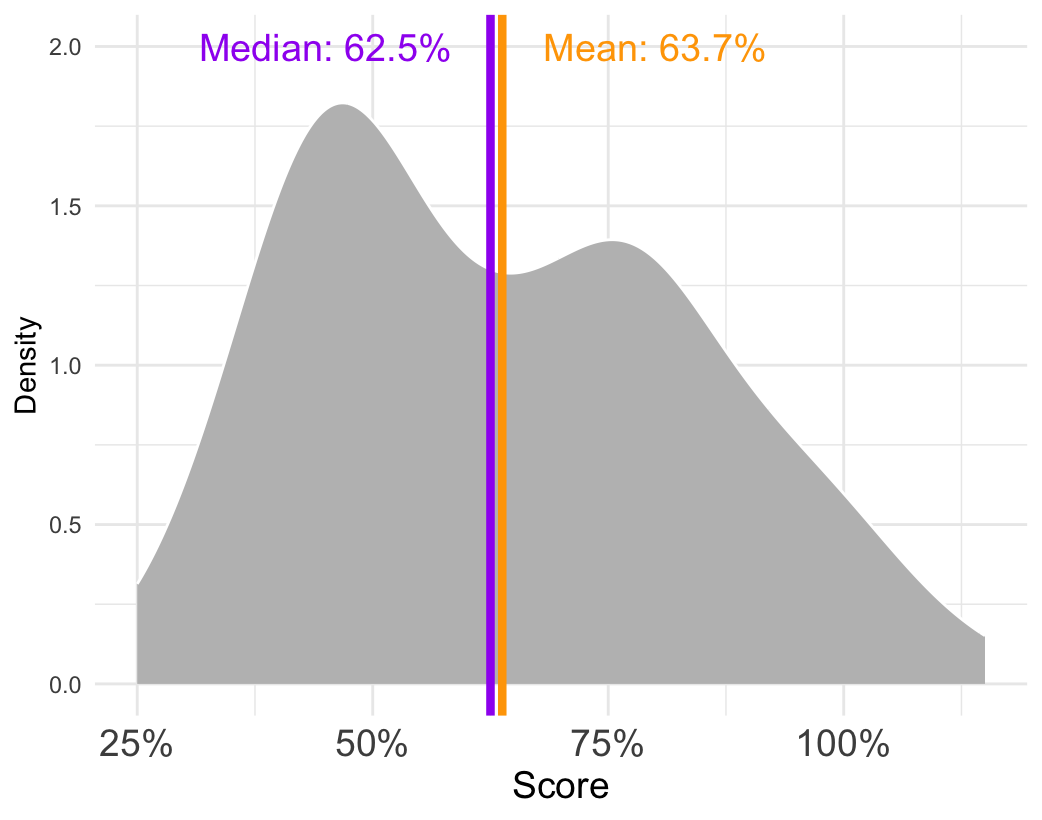
Grade Distribution for Midterm 1
Advice and Reminders
Each midterm is 15% of your grade; there are two midterms
The grade scale for the course:
- A: 80% and above
- B: 70% - 79%
- C: 60% - 69%
- D: 50% - 59%
- F: under 50%
The first midterm included questions based on Achieve assignments and iClicker questions from lecture: it’s a good idea to study these
Office hours are open: no reservation needed
The UIC Econ Club offers free tutoring
Feedback
Any questions about the midterm?
Any feedback on how to use discussion section time?
Question #24 (Bonus Question)
A blueberry farm produces $1,000,000 worth of blueberries. It sells $700,000 of blueberries to consumers and $100,000 to General Mills, which will use the blueberries to make its blueberry muffin mix. The remaining $200,000 of blueberries are unsold and placed in the farm’s storage facility. Total final expenditures in this example are
- $700,000
- $800,000
- $900,000
- $1,000,000
Question #24 (Bonus Question)
A blueberry farm produces $1,000,000 worth of blueberries. It sells $700,000 of blueberries to consumers and $100,000 to General Mills, which will use the blueberries to make its blueberry muffin mix. The remaining $200,000 of blueberries are unsold and placed in the farm’s storage facility. Total final expenditures in this example are
- $700,000
- $800,000
- $900,000
- $1,000,000
Answer
The $100,000 of blueberries sold to General Mills is an intermediate good since it’s being used to make a final good. The rest represent expenditures for GDP purposes: $700,000 is consumer spending (C) and $200,000 is a change in inventory which counts toward investment (I).
Question #5
What effect will unusually cold winter weather have on the supply and demand for sweaters?
- increase the demand and quantity supplied of sweaters
- increase the supply and quantity demanded of sweaters
- increase both the demand and supply of sweaters
- increase both the quantity demanded and quantity supplied of sweaters
Question #5
What effect will unusually cold winter weather have on the supply and demand for sweaters?
- increase the demand and quantity supplied of sweaters
- increase the supply and quantity demanded of sweaters
- increase both the demand and supply of sweaters
- increase both the quantity demanded and quantity supplied of sweaters
Answer
Cold winter weather will affect the demand for sweaters but not the supply. As consumers demand more sweaters because of the cold, the demand curve will shift upward while the supply curve stays the same, meaning there’s an increase in demand and an increase in the quantity supplied.
Draw a graph to convince yourself of this.
Question #13
The core inflation rate is equal to the inflation rate of all goods and services except for the prices of
- housing and food
- housing and health
- health and energy
- food and energy
Question #13
The core inflation rate is equal to the inflation rate of all goods and services except for the prices of
- housing and food
- housing and health
- health and energy
- food and energy
Answer
See Dr. Pieper’s inflation notes. Food and energy prices change a lot, so the inflation of all goods and services minus food and energy is generally a better measure of how inflation is moving in the long run.
Question #11
Which of the following will be included as part of US GDP?
- GM’s assembly and sale of automobiles in Mexico
- The resale of used textbooks to college students (ignore commission fees)
- The sale of wheat to Mrs. Baird’s bakery (a US firm)
- None of the above
Question #11
Which of the following will be included as part of US GDP?
- GM’s assembly and sale of automobiles in Mexico
- The resale of used textbooks to college students (ignore commission fees)
- The sale of wheat to Mrs. Baird’s bakery (a US firm)
- None of the above
Answer
The cars are made and sold in another country: it doesn’t affect US GDP, even if GM is a US-based company.
Resold or used goods don’t count toward GDP, only new final goods.
Wheat is an intermediate good that Mrs. Baird’s bakery uses to make bread, not a final good.
Question #6
Which of the following would shift the demand curve for rice rightward?
- Improved technology for growing rice
- An increase in population in rice-consuming countries
- A decrease in the price of rice
- All of the above
Question #6
Which of the following would shift the demand curve for rice rightward?
- Improved technology for growing rice
- An increase in population in rice-consuming countries
- A decrease in the price of rice
- All of the above
Answer
An increase in the number of people who consume rice will shift the demand curve for rice rightward. A decrease in the price of rice would change the quantity demanded for rice, but not the demand curve. Improved rice-growing technology would affect the supply curve for rice, not the demand curve.
Question #12
If inflation is 3% and real GDP is growing at 2%, then the growth rate of nominal GDP is equal to
- 1%
- 1.5%
- 5%
- 6%
Question #12
If inflation is 3% and real GDP is growing at 2%, then the growth rate of nominal GDP is equal to
- 1%
- 1.5%
- 5%
- 6%
Answer
The real GDP growth rate is the nominal GDP growth rate net of the inflation rate (this is just like the real interest rate formula, but for the GDP growth rate):
\[ \begin{align} \text{R GDP Growth}\% &= \text{N GDP Growth}\% - \text{Inf.}\% \\ \text{R GDP Growth}\% + \text{Inf.}\% &= \text{N GDP Growth}\% \\ 2\% + 3\% &= 5\% \end{align} \]
This is not a formula to memorize: know that real values are nominal values net of (minus) inflation.