
ECON 121 Discussion: Week 14
Slides available here:
All discussion slides here:

Today’s Plan
- Review fiscal policy
- Practice problems
Government Economic Policy
Last week we talked about two types of output gaps: inflationary gaps and recessionary gaps. Both of these are problematic! Can governments do anything to respond to these gaps and try to close them? Yes!
Two categories:
Fiscal policy: using taxes, transfers, and/or government spending to shift the aggregate demand curve
Monetary policy: using interest rates or the supply of money to influence macroeconomic factors
Examples
Fiscal policy:
Various tax credits like the Child Tax Credit
Parts of the New Deal during the Great Depression
Monetary policy (all done by central banks):
Buying and selling government bonds from banks
Changing how much banks have to hold in “reserve”
Lending to banks and adjusting the rates on those loans
Government Economic Policy
Major similarities/differences between fiscal and monetary policy:
Fiscal policy:
Direct: often means more/less money in peoples’ or businesses’ pockets
Done by Congress or the President
Usually done via political processes: passing laws, changing government policy, setting government budgets, etc.
Monetary policy:
Indirect: involves changing interest rates, which then effects other aspects of the economy
Done by central banks (in the U.S.: the Federal Reserve or “Fed”)
Independent of political processes: central bank economists set monetary policy without input from legislative bodies or political leaders
This week we will focus on fiscal policy
Expansionary Fiscal Policy
Expansionary fiscal policy: fiscal policy that increases aggregate demand
Usually involves one or more of three things:
Increasing government expenditures on goods and services (\(\uparrow\) \(G\) in the GDP equation)
Cutting taxes
Increasing government transfers (like social security or welfare programs)
Question: when would the government want to use expansionary fiscal policy? When there is what kind of output gap?
Contractionary Fiscal Policy
Contractionary fiscal policy: fiscal policy that decreases aggregate demand
Also usually involves one or more of three things:
Decreasing government expenditures on goods and services (\(\downarrow\) \(G\) in the GDP equation)
Raising taxes
Decreasing government transfers
Question: when would the government want to use contractionary fiscal policy? When there is what kind of output gap?
Star Wars Episode VI: Return of the GDP Multiplier
Case 1: the government changes its expenditures on goods and services (\(G\))
This impacts GDP in two ways:
GDP changes now by the increase/decrease in \(G\)
The government’s spending is someone else’s income: the change in \(G\) causes a chain reaction through the GDP multiplier
Case 2: the government changes amounts of taxes and/or transfer payments
Does this work in the same way? No!
We don’t have the first step in the process in Case 1: there’s no change in \(G\)!
- Remember: \(G\) does not include taxes and transfer payments
Peoples’ disposable incomes change and the GDP multiplier affects GDP as people react in changing their spending, but there’s not also the initial change in goods and services produced like in Case 1
Fiscal policy involving government purchases of goods and services will have a greater effect on GDP than fiscal policy involving changes in taxes and transfers of the same amount
Discretionary Spending vs. Automatic Stabilizers
Fiscal policy can also be categorized into two other groups:
Discretionary spending: purposeful, usually one-off, fiscal policy actions taken by a government
Automatic stabilizers: fiscal policy spending that automatically increases when output gaps become larger and automatically decreases when output gaps become smaller
Automatic stabilizers are oftentimes programs that are used more when the economy is doing poorly and less when the economy is doing well: this is why we call them “automatic”
- Example: unemployment insurance is fiscal policy that people use more of during recessions and less of during expansions
Discretionary fiscal policy is usually the result of one-time laws or other spending taken by the government
- Example: the 2021 Infrastructure Investment and Jobs Act passed under the Biden administration, which spent ~$1 trillion on road building/maintenance and other improvements
Practice Problem #1 (Part 1)
Say the government wants to increase real GDP as much as possible. What fiscal policy should it undertake?
- Raise taxes or cut transfer payments by $1 trillion
- Cut taxes or increase transfer payments by $1 trillion
- Cut spending on goods and services by $1 trillion
- Increase spending on goods and services by $1 trillion
Practice Problem #1 (Part 1)
Say the government wants to increase real GDP as much as possible. What fiscal policy should it undertake?
- Raise taxes or cut transfer payments by $1 trillion
- Cut taxes or increase transfer payments by $1 trillion
- Cut spending on goods and services by $1 trillion
- Increase spending on goods and services by $1 trillion
Answer
Options 1 and 3 would decrease aggregate demand (and so real GDP, all else equal). Between options 3 and 4, option 4 will increase aggregate demand the most.
Why? See part 2…
Practice Problem #1 (Part 2)
In Part 1, either cutting taxes/increasing transfer payments by $1 trillion (option 2) or increasing spending on goods and services by $1 trillion (option 4) would increase real GDP, all else equal.
But increasing spending on goods and services would increase real GDP more. Why?
- Increasing \(G\) raises GDP immediately and then the GDP multiplier effect also raises GDP
- Because raising \(G\) involves stimulating business activity, which raises AD more than increasing consumers’ disposable income
- Because businesses don’t save money like consumers, so the GDP multiplier for businesses is greater than for consumers
- Tax cuts or higher transfer payments have to be budget neutral, so this will decrease AD in the future
Practice Problem #1 (Part 2)
In Part 1, either cutting taxes/increasing transfer payments by $1 trillion (option 2) or increasing spending on goods and services by $1 trillion (option 4) would increase real GDP, all else equal.
But increasing spending on goods and services would increase real GDP more. Why?
- Increasing \(G\) raises GDP immediately and then the GDP multiplier effect also raises GDP
- Because raising \(G\) involves stimulating business activity, which raises AD more than increasing consumers’ disposable income
- Because businesses don’t save money like consumers, so the GDP multiplier for businesses is greater than for consumers
- Tax cuts or higher transfer payments have to be budget neutral, so this will decrease AD in the future
Answer
When the government increases \(G\), this directly boosts real GDP and then indirectly boosts it via the GDP multiplier effect. The latter happens because the government’s expenditures on goods and services is someone else’s income.
We won’t see the same effect if the government cuts taxes or increases transfer payments because taxes and transfer payments don’t directly effect GDP.
Practice Problem #1 (Part 3)
Think again about the options to increase government expenditures on goods and services by $1 trillion or cut taxes/increase transfer payments by $1 trillion. Say consumers’ MPC is 0.8. By how much would each policy increase real GDP?
The answers below correspond to the impacts on real GDP of Raising \(G\); Lowering \(T\)/Raising \(TR\)
- $1 trillion; $1 trillion
- $5 trillion; $5 trillion
- $1.25 trillion; $1 trillion
- $5 trillion; $4 trillion
Practice Problem #1 (Part 3)
Think again about the options to increase government expenditures on goods and services by $1 trillion or cut taxes/increase transfer payments by $1 trillion. Say consumers’ MPC is 0.8. By how much would each policy increase real GDP?
The answers below correspond to the impacts on real GDP of Raising \(G\); Lowering \(T\)/Raising \(TR\)
- $1 trillion; $1 trillion
- $5 trillion; $5 trillion
- $1.25 trillion; $1 trillion
- $5 trillion; $4 trillion
Answer
Use the GDP multiplier, \(\frac{1}{MPS}\). MPC = 0.8, so MPS = 1 - MPC = 0.2. So the GDP multiplier is \(\frac{1}{0.8}\) = 5.
For the option where we increase \(G\), the impact on real GDP is 1 trillion \(\times \frac{1}{0.2}\) = 1 trillion \(\times\) 5 = $5 trillion.
For the other option decreasing \(T\)/increasing \(TR\), the original GDP multiplier is still 5 but the $1 trillion is going directly into consumers’ disposable income and consumers don’t spend all of that money! They’ll spend 80% of it because MPC = 0.8. So the effect on real GDP is 0.8 \(\times\) 1 trillion \(\times\) 5 = $4 trillion.
Practice Problem #2
Which type of fiscal policy: discretionary spending or automatic stabilizer?
The economy grows, so personal and business incomes increase and so do tax payments
President Trump and Defense Secretary Pete Hegseth promise a $1 trillion annual defense budget
Medicare, a government program that provides seniors with health insurance, is expanded by Congress
A recession begins and applications for food-related welfare programs rise
The government increases tax rates to prevent inflation
Practice Problem #2
Which type of fiscal policy: discretionary spending or automatic stabilizer?
The economy grows, so personal and business incomes increase and so do tax payments - Automatic stabilizer
President Trump and Defense Secretary Pete Hegseth promise a $1 trillion annual defense budget - Discretionary spending
Medicare, a government program that provides seniors with health insurance, is expanded by Congress - Discretionary spending
A recession begins and applications for food-related welfare programs rise - Automatic stabilizer
The government increases tax rates to prevent inflation - Discretionary spending
Practice Problem #3
Many people think governments should be required to have a balanced budget: if the government spends money on fiscal policy, they say it needs to be able to pay for that spending in the same period.
If the government were required to have a balanced budget, what discretionary fiscal policy could it take during a recession and what effect would it have on the economy?
- Increase government spending to stimulate the economy, causing an increase in overall aggregate demand.
- Cut taxes to encourage consumer spending, which would minimize the effects of the recession.
- Cut government spending to equal tax revenue, possibly worsening the effects of a recession.
- Invest in public infrastructure that promotes employment and stimulates the economy.
Practice Problem #3
Many people think governments should be required to have a balanced budget: if the government spends money on fiscal policy, they say it needs to be able to pay for that spending in the same period.
If the government were required to have a balanced budget, what discretionary fiscal policy could it take during a recession and what effect would it have on the economy?
- Increase government spending to stimulate the economy, causing an increase in overall aggregate demand.
- Cut taxes to encourage consumer spending, which would minimize the effects of the recession.
- Cut government spending to equal tax revenue, possibly worsening the effects of a recession.
- Invest in public infrastructure that promotes employment and stimulates the economy.
Answer
During a recession we would expect tax revenue to decline because of higher unemployment and falling incomes for both consumers and businesses. So only option 3 would result in a balanced budget since spending would be equal to tax revenue.
If the government was required to cut spending because of decreased tax revenue during a recessionary gap, this would likely worsen the recessionary gap (can you explain why?).
Practice Problem #4
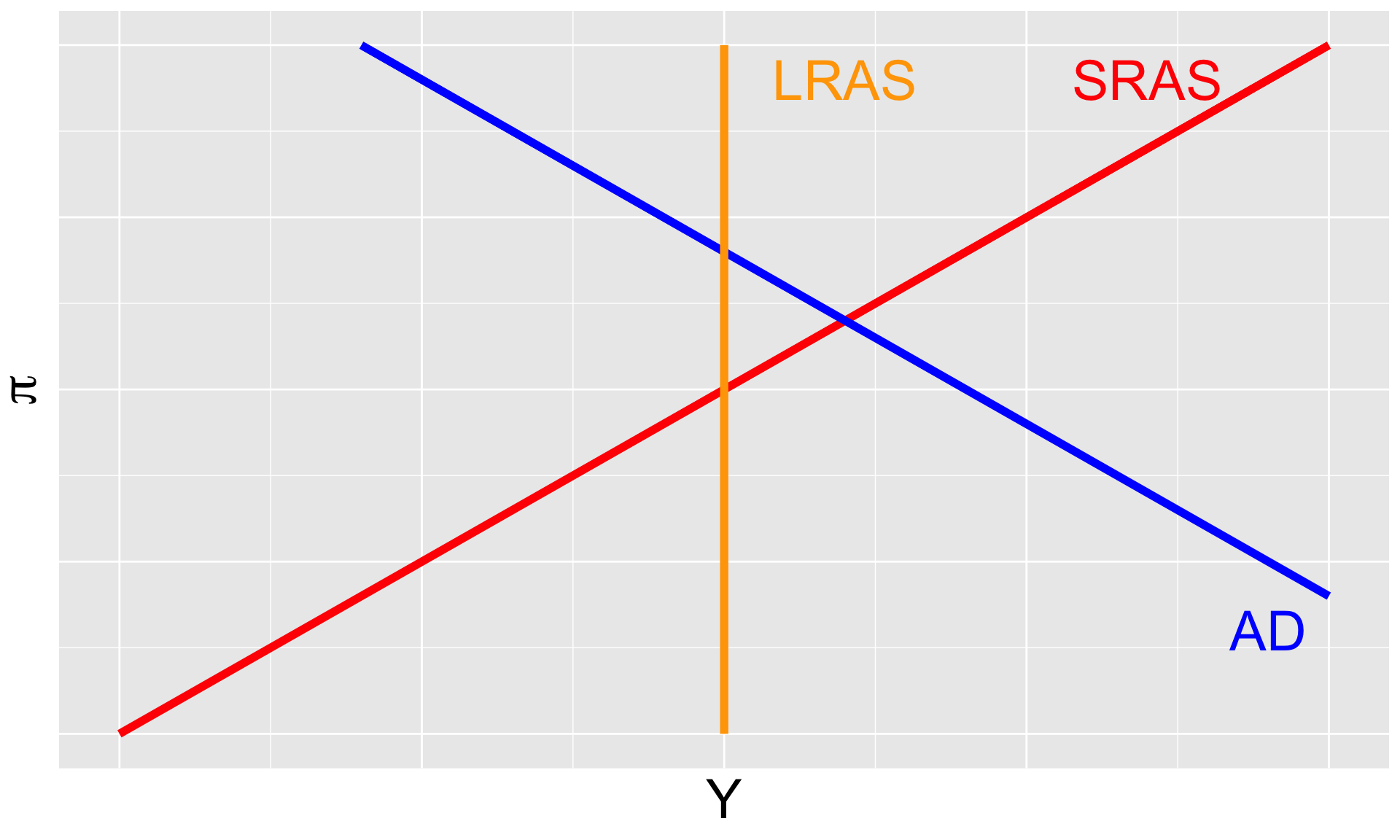
Say there’s an inflationary gap and the government is worried about a high inflation rate. What type of policy would help reduce the output gap?
- Cut taxes
- Raise taxes
- Increase government transfers
- Increase military spending
Practice Problem #4
Say there’s an inflationary gap and the government is worried about a high inflation rate. What type of policy would help reduce the output gap?
- Cut taxes
- Raise taxes
- Increase government transfers
- Increase military spending
Answer
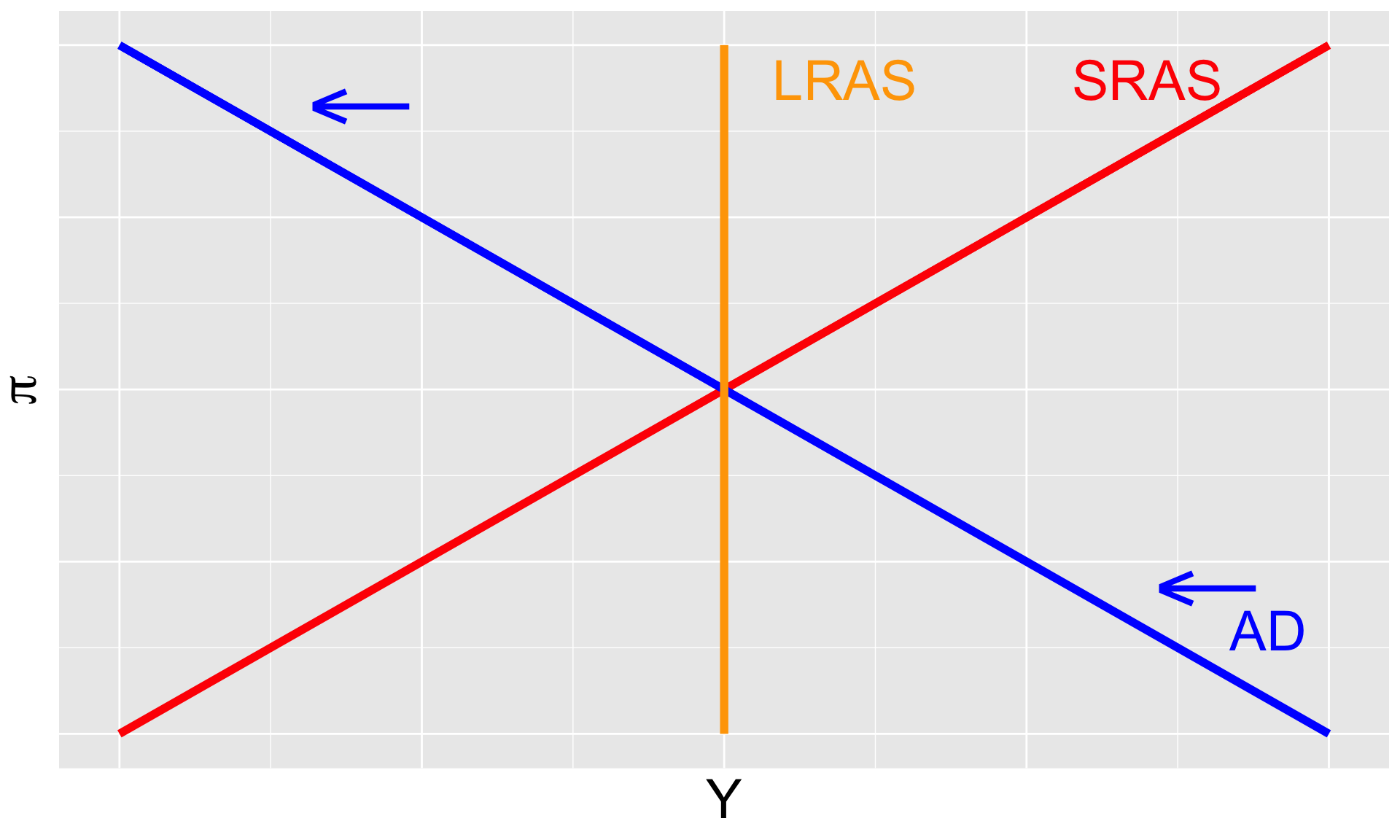
Raising taxes is a form of contractionary fiscal policy. This will reduce aggregate demand, which will decrease the inflationary gap. All of the other options would increase aggregate demand and make the inflationary gap larger.