
ECON 121 Discussion: Week 13
Slides available here:
All discussion slides here:

Today’s Plan
- Review AD/AS model and aggregate demand + supply shocks
- Practice Problems
AD/AS Model (In The Short Run)
The aggregate demand/aggregate supply model extends our demand and supply model from earlier this semester to the whole economy
Now we have the inflation rate (\(\pi\)) on the y axis instead of price and real GDP (\(Y\)) on the x axis
- Remember to think of real GDP as aggregate output: so less inflation means higher aggregate output and vice versa
The long run aggregate supply curve is a vertical line where the economy’s long run potential output is
- Potential output = what the economy could produce in the long-run if wages and prices were totally flexible
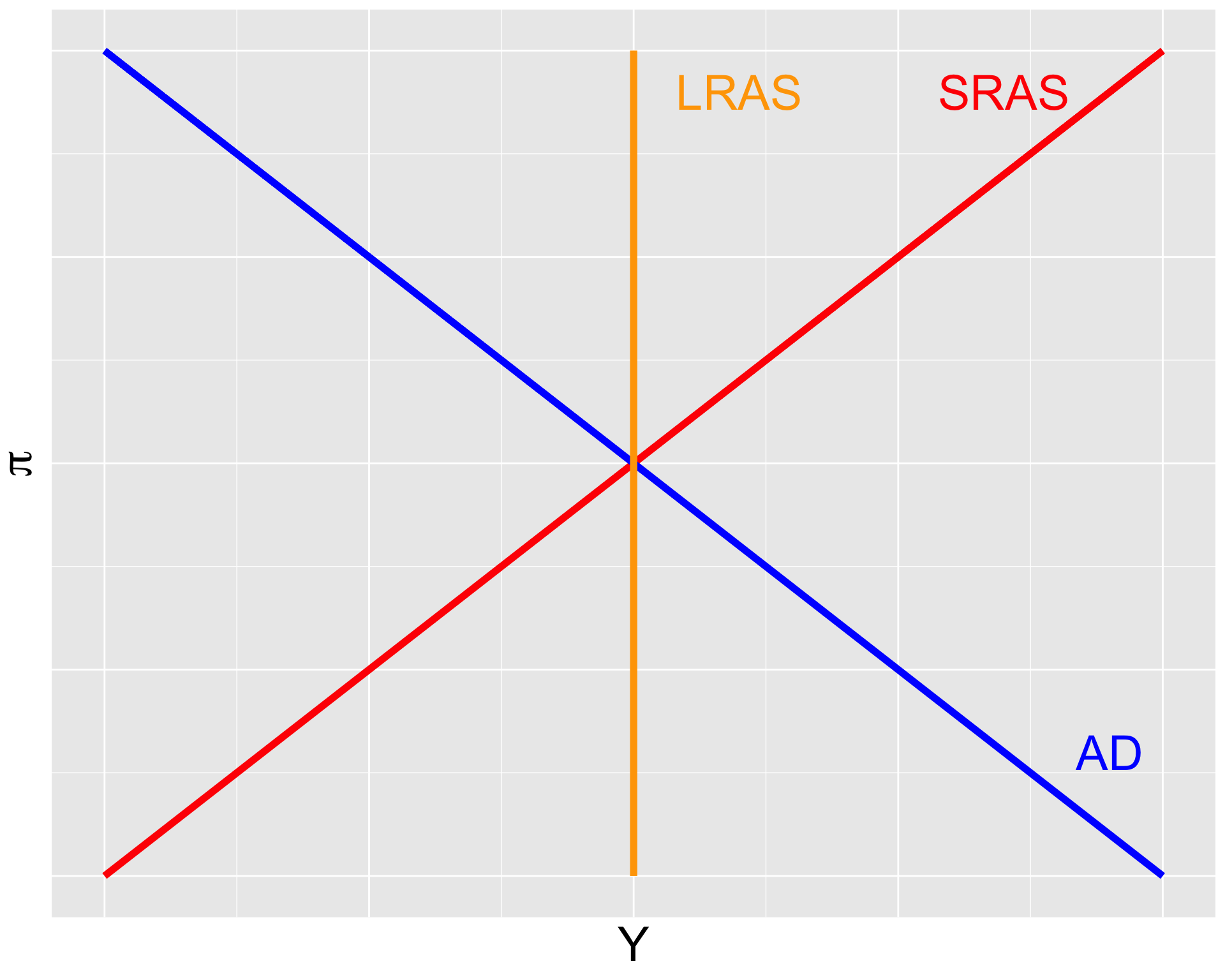
AD/AS Model
Why does less inflation mean higher real GDP?
Lower inflation \(\rightarrow\) lower prices \(\rightarrow\) more money for lending \(\rightarrow\) lower interest rates \(\rightarrow\) higher MPC \(\rightarrow\) higher aggregate spending \(\rightarrow\) higher GDP multiplier effect!
This also implies lower unemployment since more people would need to be employed to produce higher output
Demand shocks and supply shocks shift the AD and AS curves left or right
What if the short-run equilibrium isn’t where the LRAS curve is? Then there’s an output gap between actual and potential output.
Inflationary gap: when aggregate output is greater than potential output
Recessionary gap: when aggregate output is lower than potential output
In the long run, economies self-correct toward equilibrium
AD/AS Model
Make sure you understand the relationships between AD, SRAS, LRAS, inflation, real GDP, and wages
- This model and the relationships they represent will be very important as we move toward talking about fiscal and monetary policy!
Demand shock examples:
- Changes in expectations (economic optimism/pessimism)
- Changes in household wealth
- Changes in physical capital amounts
- Fiscal and monetary policy
Supply shock examples:
- Changes in commodity or input prices
- Changes in nominal wages
- Changes in productivity
Remember: it’s always a good idea to draw graphs!
Practice Problem #1
Stagflation (“stagnation” + “inflation”) happens when a shock occurs that causes both higher inflation and lower output. What type of shock would cause this?
- A positive demand shock
- A positive supply shock
- A negative demand shock
- A negative supply shock
Practice Problem #1
Stagflation (“stagnation” + “inflation”) happens when a shock occurs that causes both higher inflation and lower output. What type of shock would cause this?
- A positive demand shock
- A positive supply shock
- A negative demand shock
- A negative supply shock
Answer
Draw the scenarios in the AD/AS model to figure out which one corresponds to both higher \(\pi\) and lower \(Y\).
Keep the AD curve the same (no demand shock). Then shift the SRAS curve leftward: at the new equilibrium point, \(\pi\) will be higher and \(Y\) will be lower.
Practice Problem #2
The 2008 financial crisis was caused in part by banks and other lenders who lent too much money to people to buy houses who couldn’t afford the loans. When the Great Recession began, credit markets tightened up so that fewer people could take out loans.
What effect would this change in credit markets have on unemployment and inflation?
- Inflation and higher unemployment would follow
- Deflation and higher unemployment would follow
- Inflation would follow but there would be no effect on unemployment
- There would be no effect on inflation but there would be lower unemployment
Practice Problem #2
The 2008 financial crisis was caused in part by banks and other lenders who lent too much money to people to buy houses who couldn’t afford the loans. When the Great Recession began, credit markets tightened up so that fewer people could take out loans.
What effect would this change in credit markets have on unemployment and inflation?
- Inflation and higher unemployment would follow
- Deflation and higher unemployment would follow
- Inflation would follow but there would be no effect on unemployment
- There would be no effect on inflation but there would be lower unemployment
Answer
Draw the scenarios in the AD/AS model.
Less credit means people can spend less: imagine if you couldn’t get loans or lost your credit card. So the AD curve will shift left. There is no effect right now on the SRAS curve. Inflation will decrease and unemployment will increase because output decreases.
Practice Problem #3
Categorize the below scenarios by type of shock: positive demand shock, negative demand shock, positive supply shock, negative supply shock.
- The leader of a country enacts the highest tariffs in 100 years, causing consumer and business confidence to decline
- The COVID-19 pandemic disrupts global supply chains and car manufacturers have trouble procuring car compontents from abroad
- The government cuts tax rates by a couple percentage points across all tax brackets, increasing disposable incomes
- A government job training program boosts workers’ productivity
Practice Problem #3
Categorize the below scenarios by type of shock: positive demand shock, negative demand shock, positive supply shock, negative supply shock.
- The leader of a country enacts the highest tariffs in 100 years, increasing costs and causing consumer confidence to decline
- Negative demand shock
- The COVID-19 pandemic disrupts global supply chains and car manufacturers have trouble procuring car compontents from abroad
- Negative supply shock
- The government cuts tax rates by a couple percentage points across all tax brackets, increasing disposable incomes
- Positive demand shock
- A government job training program boosts workers’ productivity
- Positive supply shock
Practice Problem #4
A new technology that drives higher productivity is invented and companies across the economy begin to adopt it. This new technology permanently changes how people work and produce output. How does this change the aggregate price level and aggregate output in the long run?
- The price level falls and output increases
- The price level rises and output decreases
- There’s no change in the price level but output increases
- The price level increases but there’s no change in output
Practice Problem #4
A new technology that drives higher productivity is invented and companies across the economy begin to adopt it. This new technology permanently changes how people work and produce output. How does this change the aggregate price level and aggregate output in the long run?
- The price level falls and output increases
- The price level rises and output decreases
- There’s no change in the price level but output increases
- The price level increases but there’s no change in output
Answer
Draw the scenarios in the AD/AS model. Recall that inflation tells us about changes in the price level, so, for example, if inflation rises that means the price level increased.
The new technology is a positive supply shock, so the SRAS curve shifts rightward and the new equilibrium point corresponds to a lower inflation rate and higher output. Since the technology shock is permanent, this means the LRAS moves rightward as well, so the changes in inflation rate and higher output carry over into the long term.
Practice Problem #5 (Part 1)
The value of shares in the stock market suddenly jump. What would change in the AD/AS model in the short term? The long term?
Hint: think through any shifts and tell a story to arrive at an answer
- The AD curve shifts left in the short term, the LRAS curve shifts left
- The SRAS curve shifts right, the LRAS curve doesn’t change
- The SRAS curve shifts left, the LRAS curve shifts left
- The AD curve shifts right in the short term, the LRAS curve doesn’t change
Practice Problem #5 (Part 1)
The value of shares in the stock market suddenly jump. What would change in the AD/AS model in the short term? The long term?
Hint: think through any shifts and tell a story to arrive at an answer
- The AD curve shifts left in the short term, the LRAS curve shifts left
- The SRAS curve shifts right, the LRAS curve doesn’t change
- The SRAS curve shifts left, the LRAS curve shifts left
- The AD curve shifts right in the short term, the LRAS curve doesn’t change
Answer
The jump in share value is a positive change in wealth, so the AD curve will shift right. This will increase output but also the price level. Because the price level is higher, input prices are higher for firms and the SRAS curve shifts to the left. The market corrects and we end up back at an equilibrium on the LRAS curve.
The LRAS curve doesn’t move: the change in the stock market doesn’t change the potential output possible in the economy.
Practice Problem #5 (Part 2)
The initial change in the stock market initially causes an equilibrium to occur that’s not on the LRAS, creating an output gap. More specifically, what type of output gap was caused by the change in the stock market?
- Recessionary gap
- Expectations gap
- Inflationary gap
- Economic gap
Practice Problem #5 (Part 2)
The initial change in the stock market initially causes an equilibrium to occur that’s not on the LRAS, creating an output gap. More specifically, what type of output gap was caused by the change in the stock market?
- Recessionary gap
- Expectations gap
- Inflationary gap
- Economic gap
Answer
The stock market change causes the AD curve to shift rightward and the new equilibrium output is greater than the potential output represented by the LRAS curve, so this is an inflationary gap.
Practice Problem #6
Why does the SRAS slope upward while the LRAS is completely vertical?
- Firms treat production costs, like nominal wages, as fixed in the short run but these costs are flexible in the long run
- Higher inflation means less profit per unit of production and less output
- Higher inflation decreases real interest rates and so will decrease firms’ output as they spend less on investment projects
- In the short run inflation makes it easier for firms to produce but in the long run inflation doesn’t affect production
Practice Problem #6
Why does the SRAS slope upward while the LRAS is completely vertical?
- Firms treat production costs, like nominal wages, as fixed in the short run but these costs are flexible in the long run
- Higher inflation means less profit per unit of production and less output
- Higher inflation decreases real interest rates and so will decrease firms’ output as they spend less on investment projects
- In the short run inflation makes it easier for firms to produce but in the long run inflation doesn’t affect production
Answer
In the short run, changes in inflation affect output because production costs, like wages, are “sticky” or inflexible. Firms take these costs as fixed and will have to adjust their output accordingly to stay in business.
In the long run, a change in inflation means a change in all prices, including things that were sticky in the short term like wages. So inflation doesn’t affect output in the long run.