
ECON 121 Discussion: Week 12
Slides available here:
All discussion slides here:

Today’s Plan
- Midterm 2 review
Midterm 2 Review
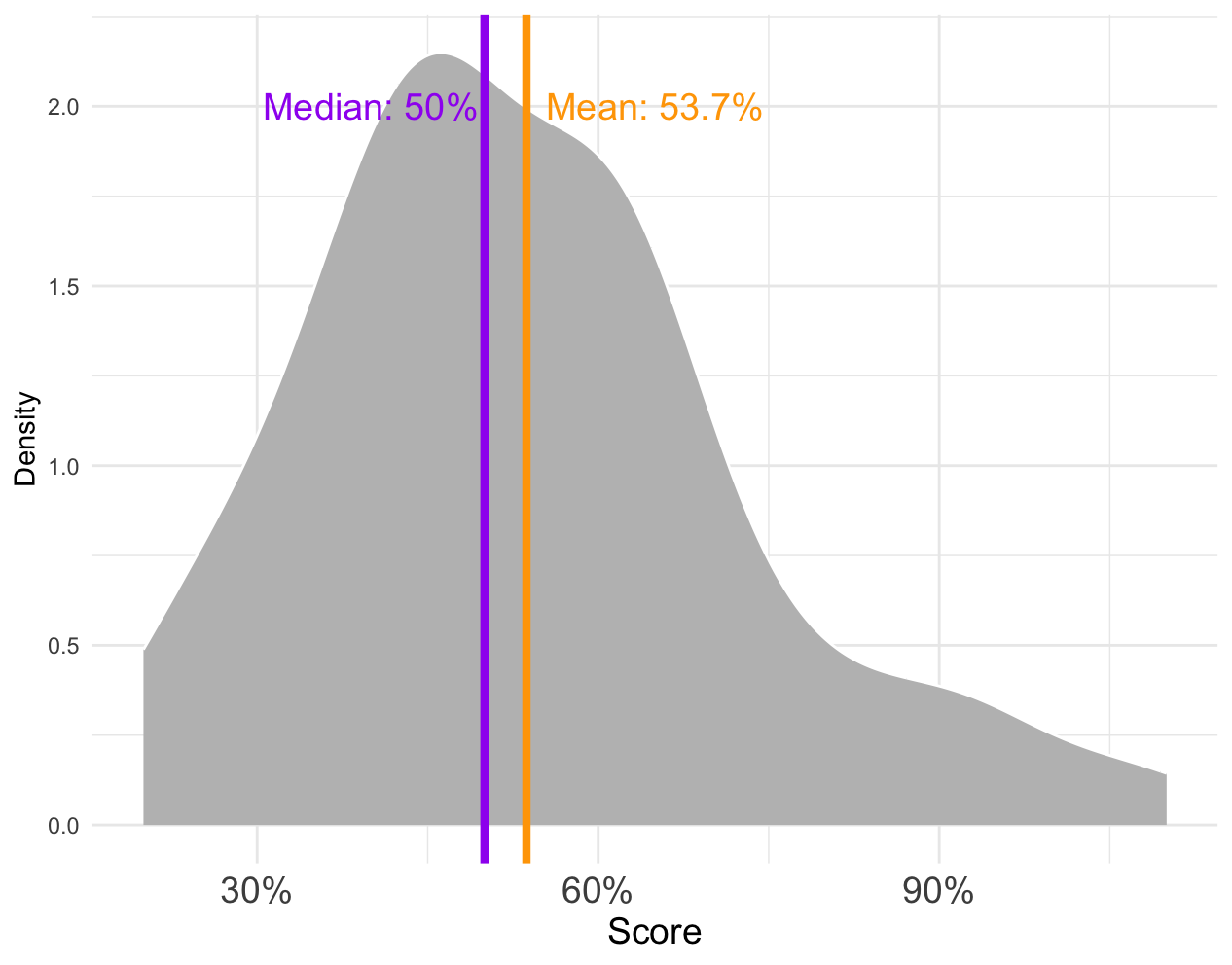
Grade Distribution for Midterm 2
Advice and Reminders
There is one exam left: the final, which is 30% of your grade
- The final will be cumulative
Start studying for the final exam early! The midterms will be good practice
- Answer keys for both exams will be posted to Blackboard if they aren’t there already
The grade scale for the course starts with an A at 80% and then goes down a grade letter in 10 percentage point increments
Office hours are open: no reservation needed
- Come to office hours to pick up exam + Scantron
The UIC Econ Club offers free tutoring
Feedback
Any questions about the midterm?
One more time: any feedback on how to use discussion section time?
Question #18
Assume the income-expenditure model where there is no government spending, taxes, or net exports. Suppose C = 500 + .75 YD and \(I_\text{Planned}\) = 600. What effect would an increase in \(I_\text{Planned}\) to 700 have on equilibrium GDP?
- 100 x .75 = 75
- 100
- 100 / .75 = 133
- 100 / .25 = 400
Question #18
Assume the income-expenditure model where there is no government spending, taxes, or net exports. Suppose C = 500 + .75 YD and \(I_\text{Planned}\) = 600. What effect would an increase in \(I_\text{Planned}\) to 700 have on equilibrium GDP?
- 100 x .75 = 75
- 100
- 100 / .75 = 133
- 100 / .25 = 400
Answer
Pay attention to the consumption function: the .75 is telling us that for an extra dollar in disposable income (YD) people spend 75 cents of it on consumption (C). So MPC = .75 and MPS must be .25.
Then use the GDP multiplier to solve for the effect of the extra planned investment on GDP:
\[ \frac{100}{\text{MPS}} = \Delta \text{GDP} \rightarrow \frac{100}{.25} = 400 \]
Question #12
Which of the following has the highest present value?
- $100 two years from now when the interest rate is 2%
- $100 two years from now when the interest rate is 5%
- $100 four years from now when the interest rate is 2%
- $100 four years from now when the interest rate is 5%
Question #12
Which of the following has the highest present value?
- $100 two years from now when the interest rate is 2%
- $100 two years from now when the interest rate is 5%
- $100 four years from now when the interest rate is 2%
- $100 four years from now when the interest rate is 5%
Answer
Present value “discounts” future money based on two factors:
- The further out in the future, the more discounted that money will be
- The higher the interest rate, the more discounted that money will be
The option that’s the nearest in the future and has the lowest interest rate will have the highest present value (i.e., the least discounting).
Question #22
Which of the following will increase planned investment?
- Higher interest rates
- High productive capacity
- All of the above
- None of the above
Question #22
Which of the following will increase planned investment?
- Higher interest rates
- High productive capacity
- All of the above
- None of the above
Answer
Higher interest rates mean borrowing to finance investment spending will be more expensive. If you expect a certain rate of return on a project for it to be worthwhile, there will be fewer projects with a >0% rate of return if interest rates go up.
Businesses make more investment expenditures when they don’t have enough productive capacity relative to demand for their products: they need more factories, equipment, etc to meet demand. They decrease their investment expenditures when their productive capacity is already high.
Question #11
What effect will an increase in expected inflation have on the supply and demand for loanable funds (assume that the nominal interest rate is on the vertical axis)?
- Shift both the supply and demand curves upward
- Shift both the supply and demand curves downward
- Shift the supply surve upward and the demand curve downward
- Shift the supply curve downward and the demand curve upward
Question #11
What effect will an increase in expected inflation have on the supply and demand for loanable funds (assume that the nominal interest rate is on the vertical axis)?
- Shift both the supply and demand curves upward
- Shift both the supply and demand curves downward
- Shift the supply surve upward and the demand curve downward
- Shift the supply curve downward and the demand curve upward
Answer
Remember that inflation erodes the value of the earned interest, so if you expect higher inflation that means you expect the real rate of interest to fall (all else equal)
\[ \text{Real Rate} = \text{Nominal Rate} - \text{Inflation} \]
If there’s more inflation and lower real interest rates, savers will want to save less. The supply curve shifts upward (or left).
If you’re borrowing loanable funds, lower real interest rates mean it’s cheaper to borrow. The demand curve shifts upward (or right).
Question #19
Equilibrium occurs in the Income-Expenditure model when
- Inflation = 0
- Unplanned inventory investment = 0
- Consumption = disposable income
- The government deficit = 0
Question #19
Equilibrium occurs in the Income-Expenditure model when
- Inflation = 0
- Unplanned inventory investment = 0
- Consumption = disposable income
- The government deficit = 0
Answer
Planned aggregate expenditures are made up of:
- Consumption expenditures
- Planned investment
There can also be unplanned investment: when firms overproduce or underproduce relative to sales and have to dip into/draw from their inventories unexpectedly.
The model is in equilibrium when there’s no unplanned investment. In this equilibrium, aggregate expenditures is equal to real GDP.
Question #20
In the income-expenditure model, if inventory investment is negative, businesses will respond by
- decreasing production
- increasing production
- decreasing prices
- increasing prices
Question #20
In the income-expenditure model, if inventory investment is negative, businesses will respond by
- decreasing production
- increasing production
- decreasing prices
- increasing prices
Answer
Inventory investment being negative means that businesses are having to dip into stored inventory from the last period to meet unexpectedly higher current demand. Businesses will increase production to make up.
This is the same thing as \(I_\text{Unplanned}\) being negative: businesses underestimated demand and produced too little.
Question #16
Which of the following must be true if GDP is greater than planned aggregate spending (\(AE_\text{Planned}\))?
- \(I_\text{Planned} < 0\)
- \(I_\text{Planned} > 0\)
- \(I_\text{Unplanned} < 0\)
- \(I_\text{Unplanned} > 0\)
Question #16
Which of the following must be true if GDP is greater than planned aggregate spending (\(AE_\text{Planned}\))?
- \(I_\text{Planned} < 0\)
- \(I_\text{Planned} > 0\)
- \(I_\text{Unplanned} < 0\)
- \(I_\text{Unplanned} > 0\)
Answer
Planned aggregate spending is made up of consumption and planned investment. The only way to have real GDP \(\neq\) aggregate spending is if there’s unplanned inventory investment.
If real GDP > planned aggregate spending, there must be positive unplanned investment. The story: business sales were lower than expected and businesses put the unsold portion of current production into inventory for next period.
Question #15
Which of the following economies would have the largest spending multiplier?
- C = 200 + .9 YD
- C = 300 + .8 YD
- C = 400 + .7 YD
- C = 500 + .6 YD
Question #15
Which of the following economies would have the largest spending multiplier?
- C = 200 + .9 YD
- C = 300 + .8 YD
- C = 400 + .7 YD
- C = 500 + .6 YD
Answer
Each of the answer options is a linear consumption function (like \(Y = m X + b\) from math class). C is consumption spending and YD is disposable income.
The intercept term, right after the equals sign, is autonomous spending: how much consumers would spend if they had no disposable income (YD = 0).
The decimal multiplying disposable income is the spending multiplier or marginal propensity to consume: it’s how much of an extra dollar of disposable income an individual would spend on consumption.